
Television has changed more in the last ten years than in the fifty before. Dishes and cable boxes are giving way to apps, and live channels now arrive over the same connection as email and video calls. So what comes next? This article looks at the future of IPTV through eight IPTV trends that are already visible today.
We work with IPTV every day, so we focus on changes that will really affect your screen, your bill and the way you find something to watch.
Key takeaways
- Better video compression will deliver sharper pictures with less data.
- AI will make discovery easier, with personal home screens instead of long lists.
- Live sports will move closer to real time thanks to low-latency streaming.
- You can enjoy many of these improvements now with a free Mom IPTV trial.
Table of Contents
What Is Driving the Future of IPTV?
Three forces drive the future of IPTV and push television toward the internet. First, broadband keeps getting faster and cheaper, with fiber and 5G reaching more homes. Second, viewers want to watch on any screen, not only on the living-room TV. Third, the cost of traditional pay-TV keeps rising, while internet delivery is cheaper to run.
Even traditional cable operators now send much of their TV over IP inside their networks. In other words, the question is no longer whether TV will move to IP, but how fast and in what form. You can read about the technology’s history on Wikipedia.
8 IPTV Trends to Watch
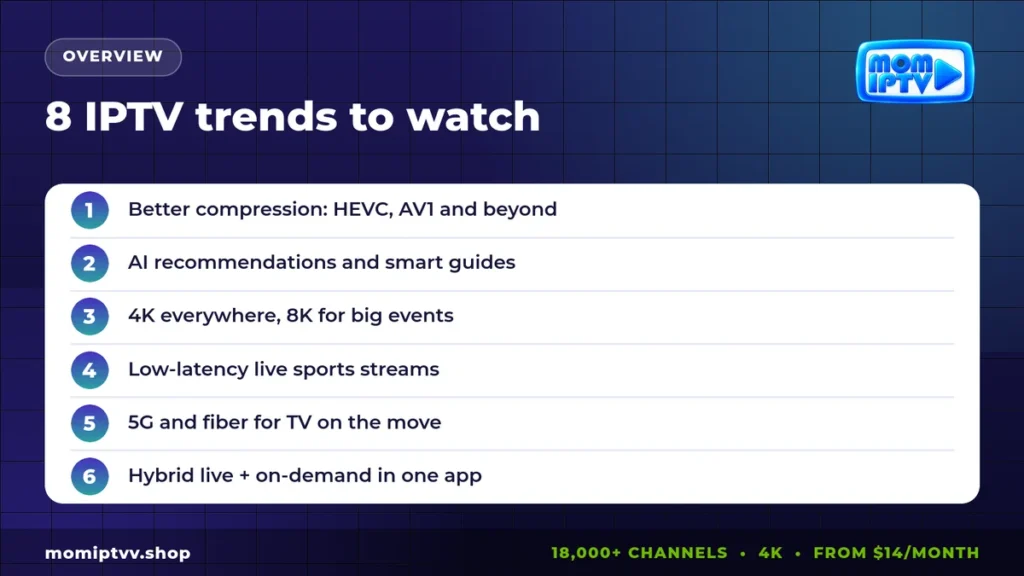
Here is a quick overview before we look at each trend in detail.
1. Smarter compression: HEVC, AV1 and next-generation codecs
A codec is the method used to shrink video so it can travel over the internet. Older streams use H.264. Many modern IPTV services, including Mom IPTV, already use H.265 (HEVC), which delivers the same quality at roughly half the bitrate.
The next step is AV1, an open codec supported by most new TVs, streaming sticks and browsers. The Alliance for Open Media designed it to cut data use further. For viewers, this means sharper pictures, fewer freezes and 4K on slower connections.
2. AI-powered recommendations and smart guides
Scrolling through thousands of channels is not fun. The next generation of IPTV apps will learn what you watch and when. Expect home screens that show the match you follow, the news channel you open every morning and new films similar to the ones you finished.
AI will also improve search. Instead of typing a channel name, you will ask for “tonight’s football in Spanish” and get a list of live and upcoming options.
3. 4K as the standard, 8K for big events
Most TVs sold today are 4K, and more channels broadcast in 4K every year. In the next few years, 4K will become the normal quality for sports and films, not a premium extra. 8K will appear for the biggest events first, such as international tournaments.
To enjoy 4K now, you need about 25 Mbps and a device that supports HEVC. Our best IPTV router guide helps you prepare your home network.
4. Low-latency live sports
One of the main complaints about streamed sport is delay: your neighbor cheers before you see the goal. New protocols such as low-latency HLS and CMAF are reducing that gap to a few seconds. In the future of IPTV, live sports will feel almost as instant as broadcast.
5. 5G and fiber: TV everywhere
5G mobile networks and fiber at home remove the last speed limits. Watching a live match in 4K on a phone, in a car or on a train will become normal. IPTV services are ready for this because they already work on every device with the same login.
6. Hybrid live and on-demand in one app
The line between live TV and on-demand is fading. Viewers expect to pause live TV, start a show from the beginning, catch up on yesterday’s episode and jump to a film, all in the same app. Services that combine live channels with a large VOD library, like Mom IPTV with 121,000+ movies and series, already follow this model. Learn more in our article what is VOD.
7. FAST channels and free ad-supported TV
FAST stands for Free Ad-Supported Streaming TV. These are linear channels that run on the internet and are paid for by ads. They will keep growing and will often sit next to paid IPTV channels inside the same app, giving viewers even more choice.
8. Stronger rules and more transparent providers
As IPTV grows, regulators and rights holders pay more attention. The future belongs to providers that are transparent: clear prices, clear refund policies, real support and stable infrastructure. For viewers who want fully licensed services, our guide to legal IPTV providers is a good start.
How the Future of IPTV Changes Your Viewing
These IPTV trends are technical, but their effect is simple. Here is what changes on your sofa.
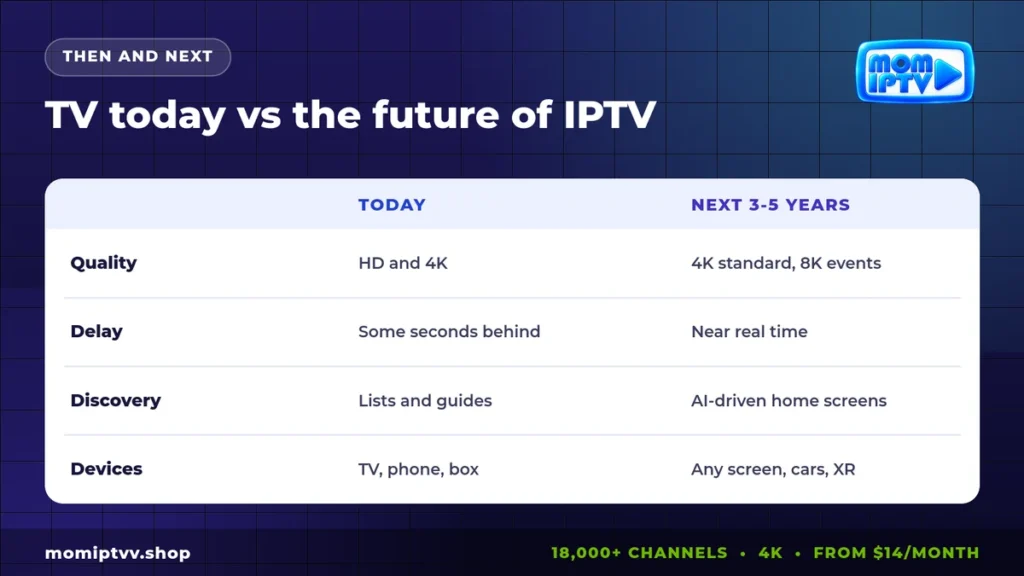
| Area | Today | In the next 3 to 5 years |
|---|---|---|
| Picture | HD and growing 4K | 4K standard, 8K for big events |
| Data use | H.264 and HEVC | AV1 and newer codecs, less data |
| Live delay | Several seconds | Close to broadcast speed |
| Finding content | Lists and EPG | AI home screens and voice search |
| Screens | TV, phone, box, PC | Every screen, including cars |
What It Means for Cable and Satellite
Cable and satellite will not disappear overnight. Satellite remains useful where internet is weak, and cable networks are turning into internet networks. But for most viewers, the future of TV is an app on any screen. If you are weighing the options today, read IPTV vs satellite TV.
Challenges Ahead for IPTV
- Network load: big events push millions of streams at once, so providers must invest in servers and backup routes.
- Device fragmentation: apps must work on many TV systems, sticks and phones.
- Rights and regulation: content licensing remains complex and differs by country.
- Trust: viewers will favor providers with clear terms and responsive support.
How to Get Ready for the Future of IPTV
- Use a streaming device that supports HEVC and AV1, such as a recent Firestick, Android TV box or Smart TV.
- Aim for at least 25 Mbps and connect your main TV with a cable.
- Choose a provider that updates its servers and supports modern players.
- Keep your apps up to date to get new features and codec support.
Not sure how to install the apps? Our setup guide covers every device.
Watch the future of TV today
18,000+ live channels, 121,000+ movies & series, HD to 4K on every device. Plans from $14/month with a money-back guarantee of up to 45 days.
Mom IPTV and the Future of TV
At Mom IPTV we build for where television is going. Our streams use efficient H.265 encoding, our servers are load-balanced with backup streams, and every plan includes live channels, catch-up on many channels and a large on-demand library. You can watch on Smart TVs, Firestick, Android, iPhone, computers, Apple TV, MAG and Enigma2.
See the Mom IPTV plans from $14 per month, or start with a free 24-hour trial and judge the quality yourself.
Future of IPTV: FAQ
Does IPTV have a future?
Yes. More viewers move from cable and satellite to internet delivery every year, and better compression, faster networks and smarter apps make IPTV more attractive.
Will IPTV replace cable TV?
In many homes it already has. Cable networks themselves now deliver TV over IP. Traditional cable will remain for some years, but the future of TV is internet-based.
What is AV1 and why does it matter for IPTV?
AV1 is a modern, royalty-free video codec that delivers the same quality as older codecs at a lower bitrate. It means sharper pictures with less buffering on the same connection.
Will 8K IPTV become common?
8K will appear first for major sports and events. 4K will become the everyday standard, because most TVs and connections already support it.
How can I prepare for the future of IPTV?
Use a recent streaming device that supports HEVC and AV1, get a stable connection of 25 Mbps or more, and choose a provider that updates its servers and apps.
Final Thoughts
The future of IPTV is sharper, faster and more personal. Compression will save data, AI will save time and new networks will bring live TV to every screen. The good news is that you do not have to wait: most of these improvements are already available with a modern device and a reliable provider.